



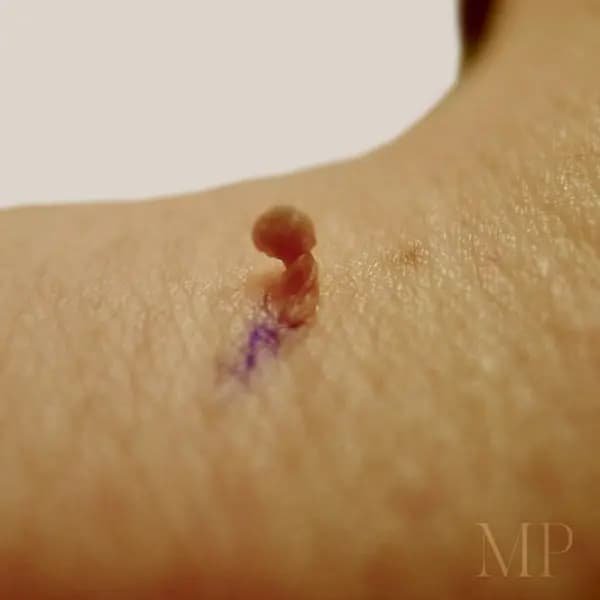
Skin Tag Removal
Why Mr Potter
Minor local anaesthetic procedure
All removed lesions sent for pathological analysis
Shower from the day after surgery
Over 1,000 skin lesions removed in the last 5 years
Less than 1% post-operative wound infection
PHIN patient satisfaction score: 99%
PHIN is an independent government audit of consultant patient outcomes, randomly sampling post-operative patients. A 99% satisfaction score places Mr Potter among the highest-rated plastic surgeons in the country.
Treatment
Skin tags
Warts and verrucas are outgrowths of hardened skin caused by viral infection. They usually resolve with time and are often amenable to treatment through a GP or over-the-counter pharmacy products. Where lesions prove resistant to conventional treatment, Mr Potter can treat them in the outpatient setting using liquid nitrogen — a controlled freeze that causes the lesion to redden, scab and lift within one to two weeks — or by surgical removal under local anaesthetic where needed.
Warts and verrucas
What Patients Say
Frequently Asked Questions
How are skin tags removed?
The most common approach is shave excision under local anaesthetic — removing the tag at its base, leaving a small flat wound that heals with minimal scarring. Larger tags may require formal excision with suture closure. Mr Potter will advise on the most appropriate technique at your consultation.
Is the procedure painful?
Local anaesthetic is used throughout. Most patients experience only minimal discomfort from the anaesthetic injection itself; the procedure is not usually associated with significant pain. Simple oral pain relief for one to two days is typically all that is needed.
Will the scar be visible?
Shave excision leaves a small flat wound that heals with minimal scarring — in most cases not noticeable. Mr Potter will explain what to expect for the specific lesion and location during consultation.
Will the removed tissue be tested?
Yes. Every lesion Mr Potter removes is sent for pathological analysis as standard.
Can warts and verrucas be treated at the same time?
Yes — where warts or verrucas are present alongside skin tags, Mr Potter can assess and treat them at the same appointment. Treatment may be liquid nitrogen in the outpatient setting or surgical removal, depending on the lesion.
Where does Mr Potter perform skin tag removal?
At the Manor Hospital in Oxford, Ridgeway Hospital in Swindon, Stratum Clinic in Wootton Oxfordshire, ProDerm in Cheltenham, and Interface Business Park in Royal Wootton Bassett.
Book a Consultation
Contact us if you have any health concerns or are looking to get a consultation. You can contact Matthew Potter by using the form below or contact him through one of the available telephone numbers or email addresses listed on this page.
Private Secretary & All Correspondence
T. 07917 965717
Swindon - Ridgeway Hospital
T. 01793 814848
Cheltenham - ProDerm, Festival House
T. 0800 0489230
Oxfordshire - Stratum Clinic,
Wootton Business Park
T. 01865 320790
Cotswold Surgical Partnership, Royal Wootton Bassett
T: 0808 2803560
Oxford - The Manor Hospital
T. 01865 307777
Contact Lissie on 07917 965717 or use the form below.