



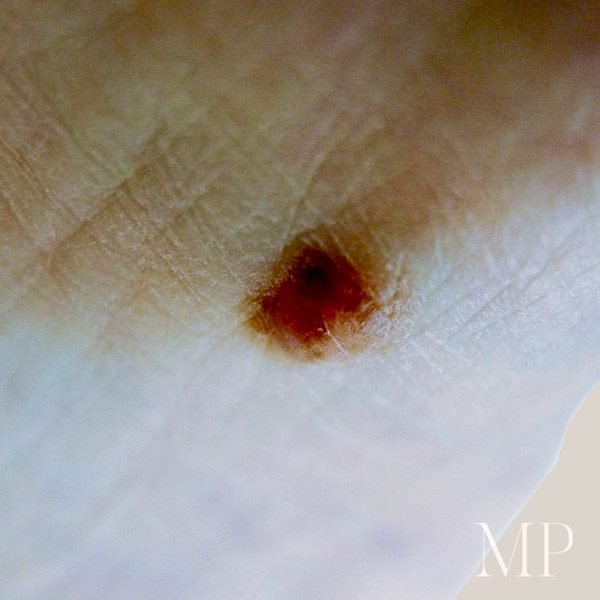
Moles & Pigmented Lesions
Why Mr Potter
Dermoscopy assessment at every consultation
All removed lesions sent for pathological analysis
Skin cancer specialist — complex or atypical lesions managed through full specialist workup
Over 1,000 skin lesions removed in the last 5 years
0% revision surgery
PHIN patient satisfaction score: 99%
PHIN is an independent government audit of consultant patient outcomes, randomly sampling post-operative patients. A 99% satisfaction score places Mr Potter among the highest-rated plastic surgeons in the country.
Assessment & Treatment
At your consultation, Mr Potter examines every lesion personally using dermoscopy — a technique that reveals structural features of the lesion not visible to the naked eye. This allows accurate assessment of whether a lesion is straightforwardly benign, warrants monitoring, or should be removed and analysed.
Dermoscopy
Surgical removal
Where a mole has significant atypical features, or where pathological analysis indicates further treatment is needed, Mr Potter has the specialist skills and clinical network to manage the full treatment pathway — including involvement of expertise in chemotherapy, immunotherapy, and radiotherapy where appropriate, and review at the skin cancer or head and neck MDT where indicated. A thorough pre-operative workup including scans will be arranged in due course.
If the lesion has atypical features
What Patients Say
Frequently Asked Questions
How does Mr Potter assess a mole?
Mr Potter examines every lesion personally using dermoscopy at your consultation. Dermoscopy reveals structural features of the lesion not visible to the naked eye, allowing accurate assessment of whether removal and analysis is required.
Will my mole be tested after removal?
Yes. Every lesion Mr Potter removes is sent for pathological analysis as standard. This confirms the nature of the tissue and whether any further action is required.
What happens if my mole shows atypical or concerning features?
Mr Potter is a skin cancer specialist with direct links to the skin cancer MDT. Where pathological analysis reveals concerning features, he manages the full treatment pathway — arranging any further workup, scans, and specialist input required. You will not be left to navigate this alone.
What surgical technique is used for mole removal?
The technique depends on the lesion type, size and location. Shave excision removes the lesion at skin level, leaving a flat healing wound. Formal excision biopsy removes the lesion with a margin of surrounding skin; the wound is closed with sutures placed within natural skin folds to minimise visible scarring. Mr Potter will explain his recommended approach at consultation.
Will there be a visible scar?
All surgical removal leaves some degree of scarring. Mr Potter selects techniques and incision placements to minimise this — particularly on the face. He will show you examples and explain what to expect during consultation.
Where does Mr Potter perform mole removal?
At the Manor Hospital in Oxford, Ridgeway Hospital in Swindon, Stratum Clinic in Wootton Oxfordshire, ProDerm in Cheltenham, and Interface Business Park in Royal Wootton Bassett.
Book a Consultation
Contact us if you have any health concerns or are looking to get a consultation. You can contact Matthew Potter by using the form below or contact him through one of the available telephone numbers or email addresses listed on this page.
Private Secretary & All Correspondence
T. 07917 965717
Swindon - Ridgeway Hospital
T. 01793 814848
Cheltenham - ProDerm, Festival House
T. 0800 0489230
Oxfordshire - Stratum Clinic,
Wootton Business Park
T. 01865 320790
Cotswold Surgical Partnership, Royal Wootton Bassett
T: 0808 2803560
Oxford - The Manor Hospital
T. 01865 307777
Contact Lissie on 07917 965717 or use the form below.