



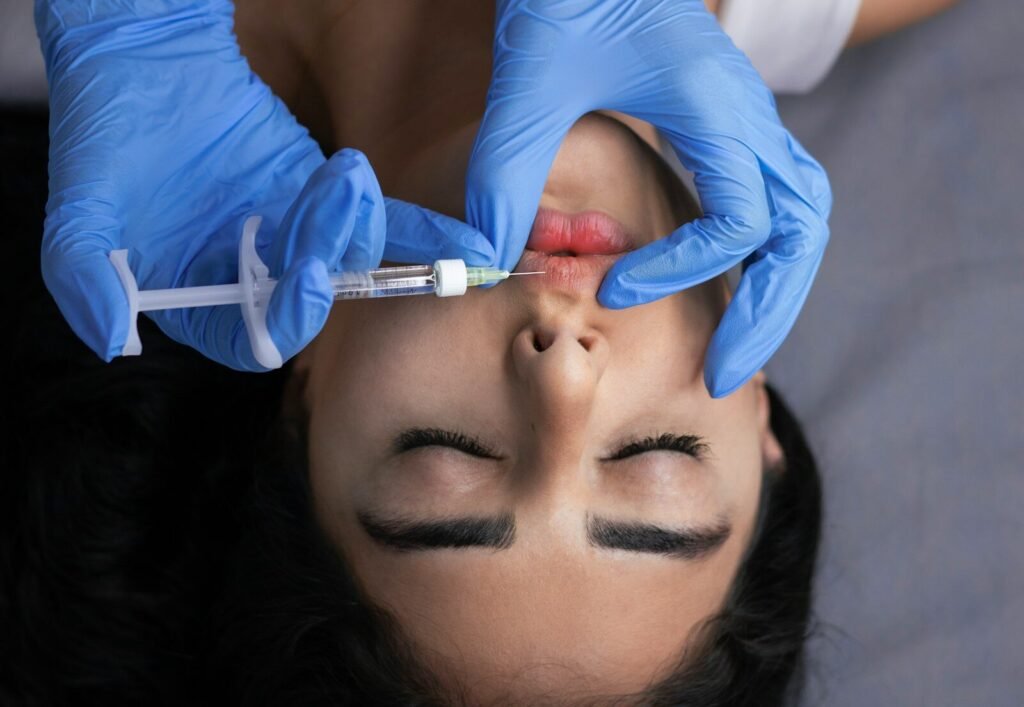
Lipofilling (Fat Grafting)
Liposculpture is a technique which describes the moving of fat from one area to another. Moving fat from one area to another historically gave poor results. This was because of a poor understanding of how the fat survives or why it fails to “take.” Advances in the understanding of fat and the cells involved in its transfer have led to an increase in its use in the rejuvenation of the face
and elsewhere as reliable results are more readily attained.
Fat can now be reliably transferred from an area of excess to an area where there is a defect or where fat volume has been lost. The fat is harvested using specialist liposuction cannulas that have been developed to cause minimal trauma to the fat. This allows for successful liposculpture and take of the fat. The rate of take varies according to the technique involved but is approximately
70-80%. This means that the area may well be over filled to allow for fat loss after the procedure.
Liposculpture and lipofilling uses your own cells to create a natural look. Unlike alterative filling
materials its removal, if ever needed, is straight forward in that this can be lipo-sucked. Liposculpting can therefore fill large contour irregularities but also can increase the volume of small areas that have been lost with time such as areas within the face. Lipofil in this area uses smaller
volumes of fat but placed in delicate areas.
Why Mr Potter
16 years performing ear correction surgery
0% long-term pain
0% return to theatre for post-operative complications
0% suture failure
PHIN patient satisfaction score: 99%
PHIN is an independent government audit of consultant patient outcomes, randomly sampling post-operative patients. A 99% satisfaction score places Mr Potter among the highest-rated plastic surgeons in the country.
Advances in Lipofilling (microfat)
creases and facial fine lines
Nanofil.
Post operative Care
After leaving the hospital you should shower all surgical sites daily.
You will be given simple oral pain killers which should be sufficient to cope with the post operative
pain that usually lasts for 2-3 days.
You should mobilise and gently walk as soon as possible. The donor areas may well ooze and you
will be given surgical absorbent pads to take home to cover these areas after showering.
At both recipient and donor sites there is likely to be bruising which should settle within a week.
The recipient site will have swelling which will worsen over the first 48 hours. This will then
gradually decrease.
You will be reviewed a week after the procedure at a cosmetic nurse follow up clinic. You will be reviewed by Mr Potter at 2 weeks after the procedure and at successive appointments until all has
settled.
The Procedure
areas this can be done under local anaesthetic.
The procedure involves harvesting the fat from sites discussed with yourself in the outpatient setting that would yield sufficient fat. The fat is purified through centrifugation to yield a high concentration of viable cells. The purified fat is then carefully injected into the site in question through a tiny incision. A small suture is used to close the incision site at both the donor and recipient area. The operative recipient site will be covered with skin coloured surgical tape and the donor areas covered with similar tape as well as surgical absorbent pads.
Liposculpture is commonly undertaken as a day case procedure.
Book a Consultation
Contact us if you have any health concerns or are looking to get a consultation. You can contact Matthew Potter by using the form below or contact him through one of the available telephone numbers or email addresses listed on this page.
Private Secretary & All Correspondence
T. 07917 965717
Swindon - Ridgeway Hospital
T. 01793 814848
Cheltenham - ProDerm, Festival House
T. 0800 0489230
Oxfordshire - Stratum Clinic,
Wootton Business Park
T. 01865 320790
Cotswold Surgical Partnership, Royal Wootton Bassett
T: 0808 2803560
Oxford - The Manor Hospital
T. 01865 307777
Contact Lissie on 07917 965717 or use the form below.