



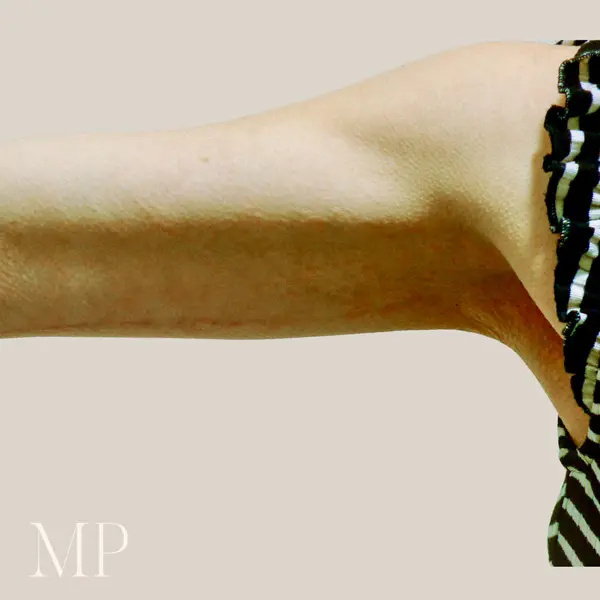
Arm Lift | Brachioplasty
Why Mr Potter
16 years experience.
0% unplanned return to theatre
0% revision
0% wound dehiscence
Average post-operative stay: 1 night
PHIN patient satisfaction score: 99%
PHIN is an independent government audit of consultant patient outcomes, randomly sampling post-operative patients. A 99% satisfaction score places Mr Potter among the highest-rated plastic surgeons in the country.
Our Technique
Preparing for Surgery
Your Recovery
Recovery Timeline
Days 1 – Shower with tape in place; wash thoroughly and allow to air dry; drains removed if used
Days 1–2 – Oral pain relief as needed — most patients need it for two days only
Days 3–5 – Wound tapes begin to peel; trim at home
7 days – Wound review at original hospital
3 weeks – Review with Mr Potter
3 months – Further review
6 weeks – Strenuous exercise avoided until this point
8 weeks – Return to normal activities
Do's & Don'ts
- Shower with tape in place from day one; wash thoroughly and allow to air dry
- Take oral pain relief for the first two days as needed
- Avoid strenuous exercise for 6 weeks
- Avoid lifting heavy weights for 6 weeks
- Do not drive until you can safely perform an emergency manoeuvre
- Return to normal activities at 8 weeks
The Procedure
Most patients stay one night in hospital. Some cases are undertaken as a day case. Mr Potter injects the area with local anaesthetic during the procedure to limit post-operative pain.
- Scarring — scars run from the armpit to the elbow on the inner arm; initially puckered, settling to flat at around one month; in severe cases a Y-shaped scar at each end minimises the overall length; abnormal lumpy or raised scarring is rare
- Swelling and bruising — expected; settles within a week; rarely the forearm may swell and take longer to settle; in rare cases compression garments may be needed long-term
- Pain — Mr Potter injects the area with local anaesthetic during the procedure; oral pain relief typically needed for two days only
- Changes in arm sensation — altered sensation around the operative site is common and should resolve with time; rarely, patients are left with areas of numbness in the forearm
- Infection or wound breakdown — uncommon
- Bleeding / haematoma — rare; drains may be placed if the operative site is particularly oozy
- Asymmetry — pre-existing asymmetry between the arms is common and likely to persist to some degree after surgery
- Fat necrosis — rare; may cause lumps or an oily discharge; managed with dressings or massage
- Over / under resection — Mr Potter errs toward under-resection; more straightforwardly corrected than over-resection
- DVT / pulmonary embolus — specialist stockings and blood-thinning injections are provided during your stay
- Further procedures — where any adjustments are needed, Mr Potter and his hospital teams are happy to facilitate further surgery
What Patients Say
Frequently Asked Questions
What is brachioplasty?
Brachioplasty — commonly called an arm lift — removes excess skin and fat from the inner upper arm, from the armpit to the elbow. It is most commonly sought by patients who have experienced significant weight loss or whose skin has lost elasticity with age.
Will there be visible scarring?
Yes — brachioplasty produces a permanent scar running along the inner arm from the armpit to the elbow. The scar is placed on the inside of the arm to minimise visibility. It is initially puckered, settling to flat at around one month. Mr Potter will discuss what to expect during consultation.
Can arm lift be combined with liposuction?
Yes — where fat excess is also present, liposuction is performed alongside excision to produce a more complete result. Mr Potter will advise on the most appropriate approach for your anatomy.
How long is the recovery?
Most patients return to office-based work within two weeks. Strenuous exercise and heavy lifting should be avoided for six weeks. Mr Potter reviews you at seven days, three weeks, and three months.
Where does Mr Potter perform arm lift surgery?
At the Manor Hospital in Oxford, Ridgeway Hospital in Swindon.
Book a Consultation
Contact us if you have any health concerns or are looking to get a consultation. You can contact Matthew Potter by using the form below or contact him through one of the available telephone numbers or email addresses listed on this page.
Private Secretary & All Correspondence
T. 07917 965717
Swindon - Ridgeway Hospital
T. 01793 814848
Cheltenham - ProDerm, Festival House
T. 0800 0489230
Oxfordshire - Stratum Clinic,
Wootton Business Park
T. 01865 320790
Cotswold Surgical Partnership, Royal Wootton Bassett
T: 0808 2803560
Oxford - The Manor Hospital
T. 01865 307777
Contact Lissie on 07917 965717 or use the form below.