




Breast Augmentation
Why Mr Potter
16 years performing breast augmentation
0% capsule contracture
0% long-term nipple or areolar sensation loss
0% ALCL (implant-associated lymphoma)
0% delayed implant exchange
0% redo operations for poor implant position or movement
0% long-term pain
Average post-operative stay: 1 night
Return to office work: 2 weeks on average
Unplanned return to theatre: a single case of haematoma delaying discharge by 1 day
PHIN patient satisfaction score: 99%
PHIN is an independent government audit of consultant patient outcomes, randomly sampling post-operative patients. A 99% satisfaction score places Mr Potter among the highest-rated plastic surgeons in the country.
Implant Selection
A joint decision, made across several consultations
Implants can be placed either beneath the breast tissue or beneath the pectoral muscle — a technique known as dual plane placement. The right position depends on the amount of existing breast tissue and the result you are seeking. Mr Potter will discuss both options and his recommendation during your consultations.
Placement
Shell: soft silicone exterior in all cases
Fill: silicone or saline core
Shape: round or anatomical (tear-shaped)
Incision: infra-mammary only — hidden beneath the breast, barely visible, lowest infection risk
Surface: smooth implants only — Mr Potter restricts his implant choice exclusively to smooth, non-textured implants. Textured implants have been associated with ALCL; smooth implants have not.
Implant Options
Implants & Your Health
Patient Imagery
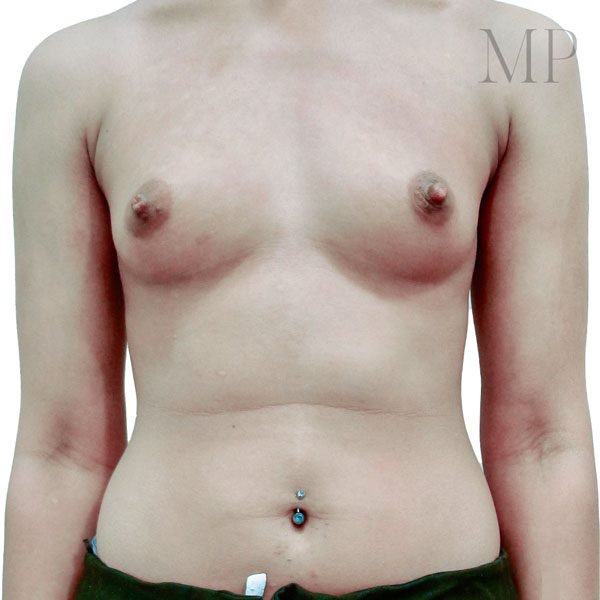
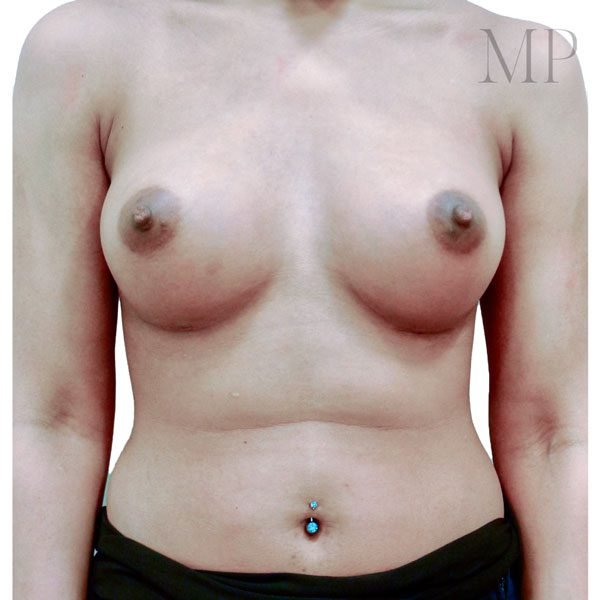
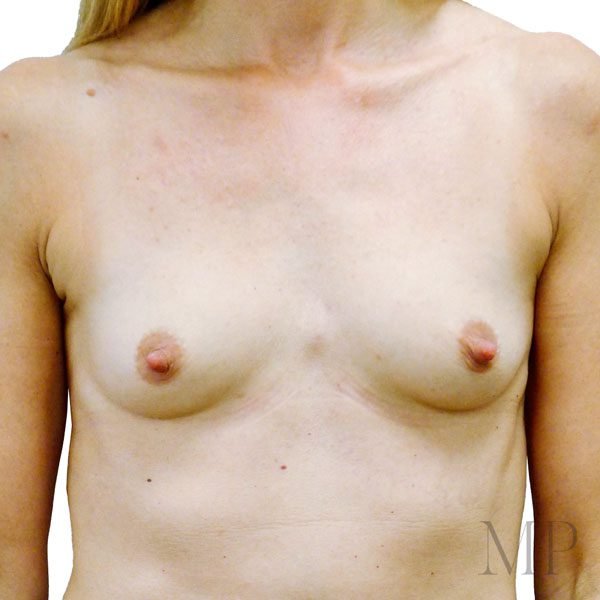
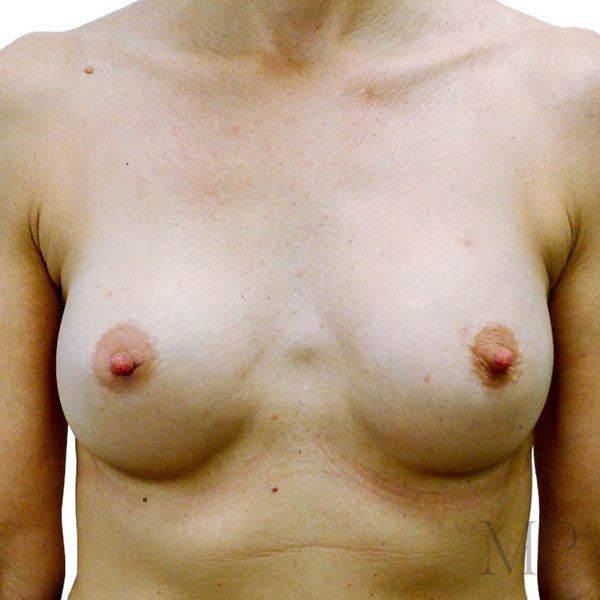
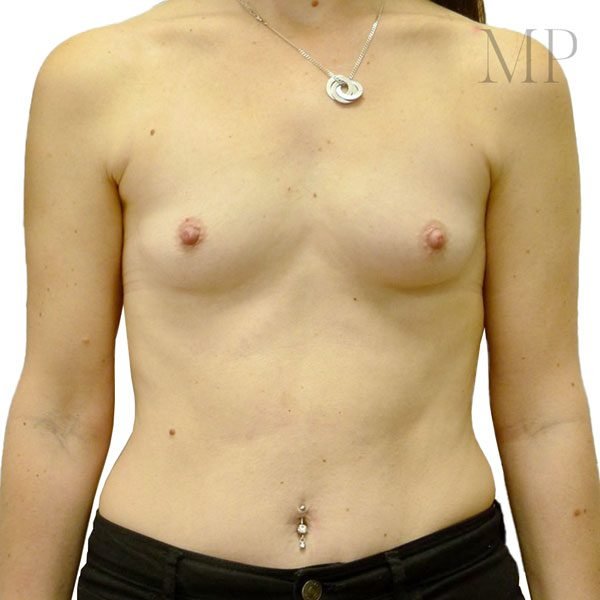
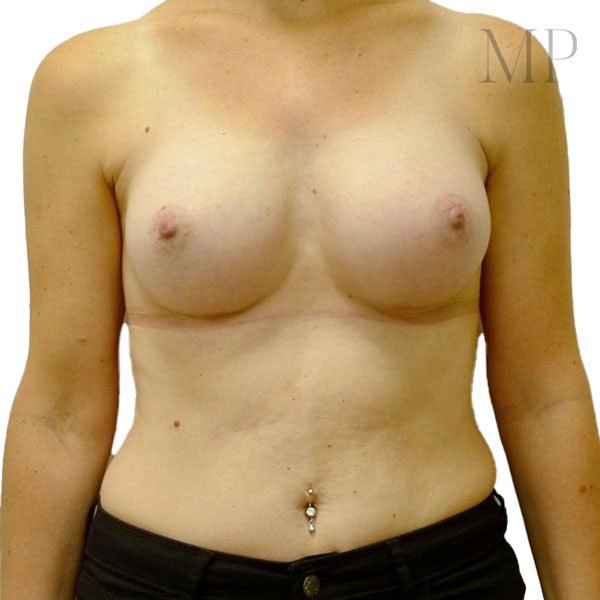
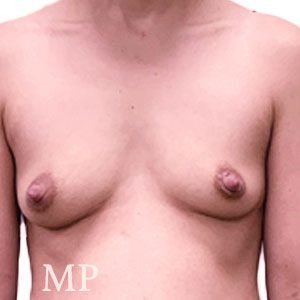
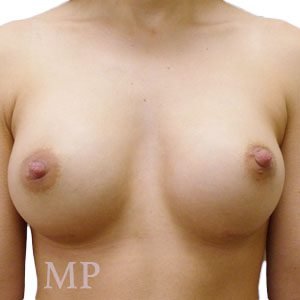
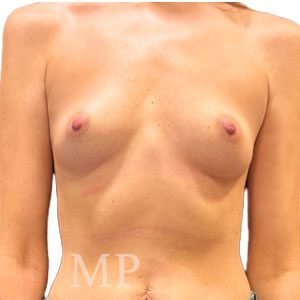
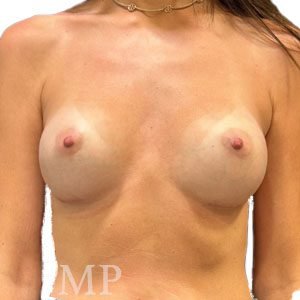
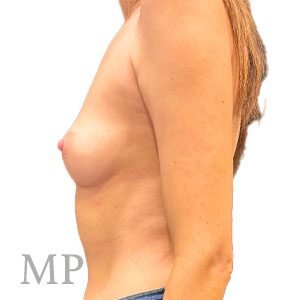
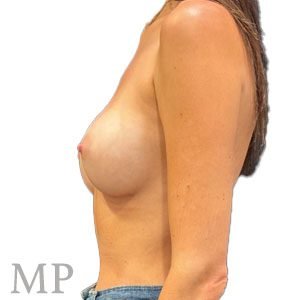
Your Recovery
Recovery Timeline
Days 1 – Dressings removed; sports bra fitted; shower encouraged; wound tapes washed and air dried
Days 1–2 – Oral pain relief as needed — most patients need it for two days only
Days 3–5 – Wound tapes begin to peel; trim at home as needed
7 days – Wound check; tapes removed at original hospital
3 weeks – Review with Mr Potter
3 months – Final result review
8 weeks – Sports bra and avoidance of underwired bras until this point
Long-term – Ongoing follow-up; implant exchange planning at approximately 10 years
Do's & Don'ts
- Wear a supportive soft sports bra day and night for 8 weeks following the procedure
- Avoid underwired bras for at least 8 weeks following complete wound healing
- Sleep on your back during the initial post-operative period
- Shower the morning after surgery; wash wound tapes thoroughly and allow to air dry
- Avoid strenuous exercise for 6 weeks
- Avoid lifting heavy weights for 6 weeks
- Avoid exercise regimes that could cause trauma to the implants
- Do not drive until you can safely perform an emergency manoeuvre
- Return to normal activities at 8 weeks
The Procedure
- Capsule contracture — scar tissue forming around the implant and contracting, causing distortion; 0% in Mr Potter’s data; where this occurs the implant can be exchanged with release of the contracted capsule
- Changes in nipple or breast sensation — usually temporary; 0% long-term loss in Mr Potter’s data
- Implant movement or malposition — 0% redo operations in Mr Potter’s data
- Infection — uncommon; the infra-mammary approach is used specifically for its lower infection risk
- Haematoma — a single case in Mr Potter’s data, delaying discharge by one day; drains are not routinely used but may be placed if the operative site is particularly oozy
- Scarring — incisions placed beneath the breast and hidden; raised wound edges flatten at around one month; abnormal scarring is rare
- ALCL — rare implant-associated lymphoma linked to textured implants; 0% in Mr Potter’s data; he uses smooth implants exclusively
- Asymmetry — pre-existing asymmetry may be emphasised by augmentation; Mr Potter will discuss this during consultation
- Implant longevity — exchange at approximately ten years is advisable; Mr Potter follows all patients long-term
- Potential inability to breast feed — breast implants do not prevent breast feeding, though this should be discussed during consultation
- DVT / pulmonary embolus — as with any procedure under general anaesthetic; specialist stockings and blood-thinning injections are provided during your stay
- Further procedures — where any adjustments are needed, Mr Potter and his hospital teams are happy to facilitate further surgery to ensure you are happy with your result
What Patients Say
Frequently Asked Questions
What is breast augmentation?
Breast augmentation is a surgical procedure that increases breast volume using silicone or saline implants. It can also correct breast asymmetry and restore upper breast fullness that cannot be achieved through uplift procedures alone.
How is the implant size decided?
Implant selection is a joint decision made across several consultations. Mr Potter uses trial implants in clinic to give you a realistic sense of different sizes and profiles, and will not finalise any decision until you are confident in the choice.
Where is the incision placed?
Mr Potter uses only the infra-mammary incision — a single incision placed beneath the breast in the natural fold, where it is barely visible. He uses this approach exclusively because it carries the lowest infection risk of all available access routes.
Why does Mr Potter use smooth implants only?
Textured implants have been associated with a rare form of lymphoma (ALCL). Smooth implants have not. Mr Potter restricts his implant choice exclusively to smooth implants — and his outcome data records 0% ALCL across his entire career.
Will breast implants affect mammography?
Breast implants do not prevent mammography or ultrasound surveillance. You should inform the radiographer about your implants before any scan. Some areas of the breast may be less visible on mammography with implants in place — your radiographer will account for this.
How long do breast implants last?
Mr Potter advises planning for an implant exchange at approximately ten years. Advances in implant technology may extend this in practice. He follows all breast augmentation patients long-term.
Can I breast feed after augmentation?
Yes. Breast implants do not prevent breast feeding.
Where does Mr Potter perform breast augmentation?
At the Manor Hospital in Oxford, Ridgeway Hospital in Swindon, Stratum Clinic in Wootton Oxfordshire, ProDerm in Cheltenham, and Interface Business Park in Royal Wootton Bassett.
Book a Consultation
Contact us if you have any health concerns or are looking to get a consultation. You can contact Matthew Potter by using the form below or contact him through one of the available telephone numbers or email addresses listed on this page.
Private Secretary & All Correspondence
T. 07917 965717
Swindon - Ridgeway Hospital
T. 01793 814848
Cheltenham - ProDerm, Festival House
T. 0800 0489230
Oxfordshire - Stratum Clinic,
Wootton Business Park
T. 01865 320790
Cotswold Surgical Partnership, Royal Wootton Bassett
T: 0808 2803560
Oxford - The Manor Hospital
T. 01865 307777
Contact Lissie on 07917 965717 or use the form below.