



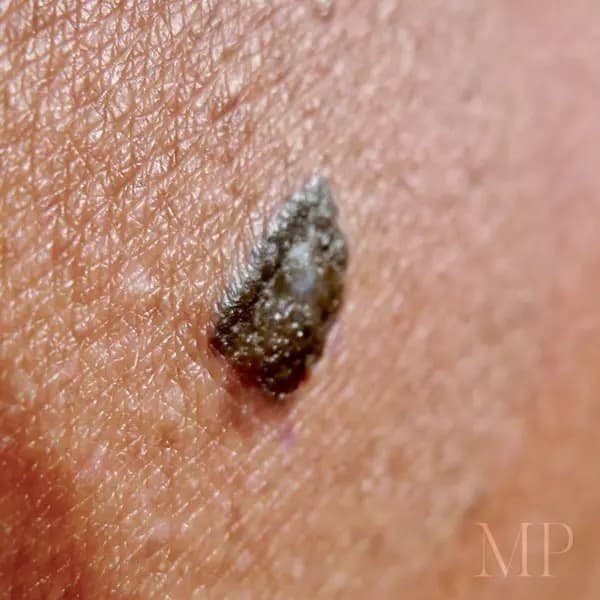
Melanoma & Sentinel Lymph Node Biopsy
Why Mr Potter
National CRUK panel member for skin cancer research and trials
Part of the international Rational MCC study into improving skin cancer outcomes
0% mortality across skin cancer surgery
PHIN patient satisfaction score: 99%
PHIN is an independent government audit of consultant patient outcomes, randomly sampling post-operative patients. A 99% satisfaction score places Mr Potter among the highest-rated plastic surgeons in the country.
How melanoma spreads
Staging
The seriousness of a melanoma is assessed through a staging system. The depth of the melanoma in millimetres indicates how far it has grown within the skin and the likelihood that it has reached lymph vessels. Knowing whether melanoma has reached the sentinel node is a key indicator of disease status — and if spread is confirmed, it allows treatment with immunotherapy to begin as early as possible.
Do's & Don'ts
- Apply antibiotic ointment to operative sites each evening for two weeks
- Sleep with two to three pillows for the first week
- Avoid coughing, straining, and bending for at least two weeks
- Avoid strenuous exercise for 6 weeks
- Take oral pain relief for the first two to three days as needed — some patients experience headache rather than operative site pain; this settles with simple oral pain relief
- Do not drive until you can safely perform an emergency manoeuvre
How melanoma develops
Locating the sentinel node
The procedure
For melanomas of the head and neck, SLNB is performed under general anaesthetic and takes approximately two hours. The radiographer marks the skin over the node’s location on the X-ray, and Mr Potter reviews both the skin marks and the imaging before proceeding. The sentinel node is identified intraoperatively using a gamma probe and its blue dye staining, then removed and sent for pathological analysis.
What is SLNB?
Sentinel lymph node biopsy is the surgical procedure that identifies and samples the first lymph node the melanoma would drain to — the sentinel node. If this node is clear of melanoma cells, it is highly likely the disease has not spread beyond the skin. If it contains melanoma, this information is critical for planning further treatment.
What Patients Say
Following removal of a melanoma five years ago, I had developed an amelanotic lentigo maligna on my face which had become quite large, as a result of not being visible. Matthew Potter and Dr Richard Turner worked closely together on this, Richard Turner determined the margins using Johnson’s technique and then Matthew Potter carried out a major surgical procedure (cervico-facial rotation).
He showed me pictures in advance of what to expect immediately after the operation and then long term, and it has worked out exactly as predicted – pretty gruesome on the day of discharge but now settled down so well that no-one notices that anything has been done, despite the scale of the surgery. I am very pleased with the result.
Done privately, as although the same procedure would have been available on the NHS, there was a much longer wait and the procedure may not have been done entirely by Matthew Potter.
I met Mr Potter prior to my melanoma op and he was very informative and helpful, explaining what he was going to do. He reassured me that the scar which looked awful on the photos he showed me, will go away and will be hardly noticeable – and he was right!
I still see him in 6 monthly intervals when he examines me very thoroughly. I can recommend Mr Potter wholeheartedly. He is a wonderful surgeon and has a lovely personality
Following a recent diagnosis of malignant melanoma I met with Matt who was very reassuring. He was very patient and understanding, explaining what had happened so far and the options that were available to me.
So far I have had a wide local excision and a sentinel lymph nodes biopsy and the surgical results have been amazing, the scars are healing very well and I am happy at how good they look already, about 1 month on.
Matt is continuing to provide excellent care, both for my physical health and emotional wellbeing, ensuring that I understand my future treatment. I feel very fortunate to be in the care of Matt and have faith in his recommended treatment plan.
After being diagnosed with a malignant melanoma on my left thigh and then a completion Lymphadenectomy. I met Mathew Potter my surgeon and I cannot speak more highly of him.
He explained the procedures clearly and he and his brilliant team gave me great confidence.He was kind, gentle and had a great sense of humour and was very professional in his procedures. I would highly recommend him….he is a total asset to his profession.
5 years ago I had skin cancer. No nonsense, spoke to me as an equal, in plain speak, jargon free. He gave me confidence from the off. I had the cancer removed along with a few lymph nodes from my elbow and armpit.
Experienced some swelling in my hand, this disappeared within a couple of weeks. I did not have chemotherapy. Ok, the next 5 years:- Tri-monthly and 6 monthly meetings with Mr Potter and the team. I was visually scanned on each occasion either by Mr Potter or “TP” the Cancer nurse.
If I had a question the Macmillan nurse “TP” was always responsive and helpful. One other integral part of the team was “OM”, always there with Mr Potter. Always friendly and as a first point of contact very reassuring. Where would I be right now without these people? Thank you so much.
I had a melanoma removed from my arm, and saw Matt after that for a Wide Local Excision and Sentinel Lymph Node Biopsy. He was extremely patient throughout and explained everything about the cancer and also the procedure thoroughly.
He even rang me the evening after surgery to check I was clear about the aftercare. The wounds have healed well leaving remarkably little scarring. I cannot fault any of my experience with Matt and would highly recommend him. Thanks very much
Mr Potter removed a lesion from the skin on my side under local anaesthetic. He was very gentle when giving me the local anaesthetic. He explained what he was doing throughout the procedure and made me feel less nervous.
I am happy that the scar left is extremely faint and hardly noticeable now. I would recommend him to others needing lumps and bumps removed.
I have recently been seen by Mr Potter for a wide local excision following a NHS initial excision. I wanted a private plastic surgeon in order to ensure the scar is at its best.
Although it is early days and the scare is healing well and the results are looking great thus far, if anyone wants a surgeon who takes time to explain what the condition is you have and has an excellent bed side manner with excellent results, I can assure you that all of these qualities and more Mr Potter displays.
I would say I am the worst patient ever and he definitely put me at ease. After care is excellent and I would not go to anyone else now that I have experienced his professional care and skills.
Dear Mr Potter, a note to say thank you for diagnosing that the facial melanoma had spread. That was in June 2016. Having had to break the news of spread you were instrumental in getting me to Dr N and the subsequent acceptance on his immunotherapy programme.
For nearly a year I have been disease free and been able to resume life including my 25th Wedding anniversary trip to Italy. My heartfelt thanks.
Frequently Asked Questions
What is a sentinel lymph node?
The sentinel lymph node is the first lymph node that receives lymphatic drainage from the site of the melanoma. Because melanoma tends to spread through the lymphatic system first, the sentinel node is the most likely place to find melanoma cells if the disease has begun to spread.
Why is sentinel lymph node biopsy important?
If the sentinel node is clear of melanoma, it is highly likely the disease has not spread beyond the skin. If it contains melanoma cells, this is critical information — it allows staging to be completed accurately and immunotherapy or other systemic treatments to begin as early as possible.
Does a positive sentinel node mean the cancer has spread throughout the body?
Not necessarily. A positive sentinel node indicates spread to the regional lymph nodes. It is concerning news, but knowing it is beneficial — it allows treatment to begin promptly, which can prevent further progression.
Will I need further surgery if my sentinel node is positive?
Mr Potter will discuss the implications of the result and any further treatment options with you. This may include completion lymph node dissection, immunotherapy, or a combination, depending on the individual case.
Where does Mr Potter perform melanoma surgery?
At the Manor Hospital in Oxford, Ridgeway Hospital in Swindon, Stratum Clinic in Wootton Oxfordshire, ProDerm in Cheltenham, and Interface Business Park in Royal Wootton Bassett.
Book a Consultation
Contact us if you have any health concerns or are looking to get a consultation. You can contact Matthew Potter by using the form below or contact him through one of the available telephone numbers or email addresses listed on this page.
Private Secretary & All Correspondence
T. 07917 965717
Swindon - Ridgeway Hospital
T. 01793 814848
Cheltenham - ProDerm, Festival House
T. 0800 0489230
Oxfordshire - Stratum Clinic,
Wootton Business Park
T. 01865 320790
Cotswold Surgical Partnership, Royal Wootton Bassett
T: 0808 2803560
Oxford - The Manor Hospital
T. 01865 307777
Contact Lissie on 07917 965717 or use the form below.